


Leonardo AI for Kids: A Parent's Complete Guide to Safe AI Art
ON THIS PAGE
Subscribe To Get Weekly Family AI Discoveries

Quick Takeaways
- Strict content filtering - Leonardo AI enforces a no-NSFW policy with automated filters that block inappropriate prompts
- Free tier available - 150 tokens per day lets families experiment before committing to a subscription
- Age restriction - Children under 13 cannot create accounts; parents should hold the account and supervise
- Privacy consideration - Free accounts make all images public; paid plans ($12+/month) allow private generations
- Browser-based - No Discord or complex setup required; works on computers, tablets, and Chromebooks
If you have been exploring AI art tools for your family, you have probably come across Leonardo AI. With over 19 million users worldwide and a recent acquisition by Canva, it has become one of the most popular generative art platforms available.
But is it appropriate for kids? The short answer is yes, with supervision. Leonardo AI enforces strict Safe-for-Work policies and blocks NSFW content by default, making it one of the safer options for family use. That said, there are important considerations around age restrictions, privacy settings, and account management that parents need to understand.
This guide covers everything you need to know: how the platform works, what it costs, how to set it up safely for your children, and practical tips for getting the best results from creative family projects.
Not sure which tool is right for your child?
Take our free 2-minute quiz and get personalized AI tool recommendations based on your child's age and interests.
What Is Leonardo AI?
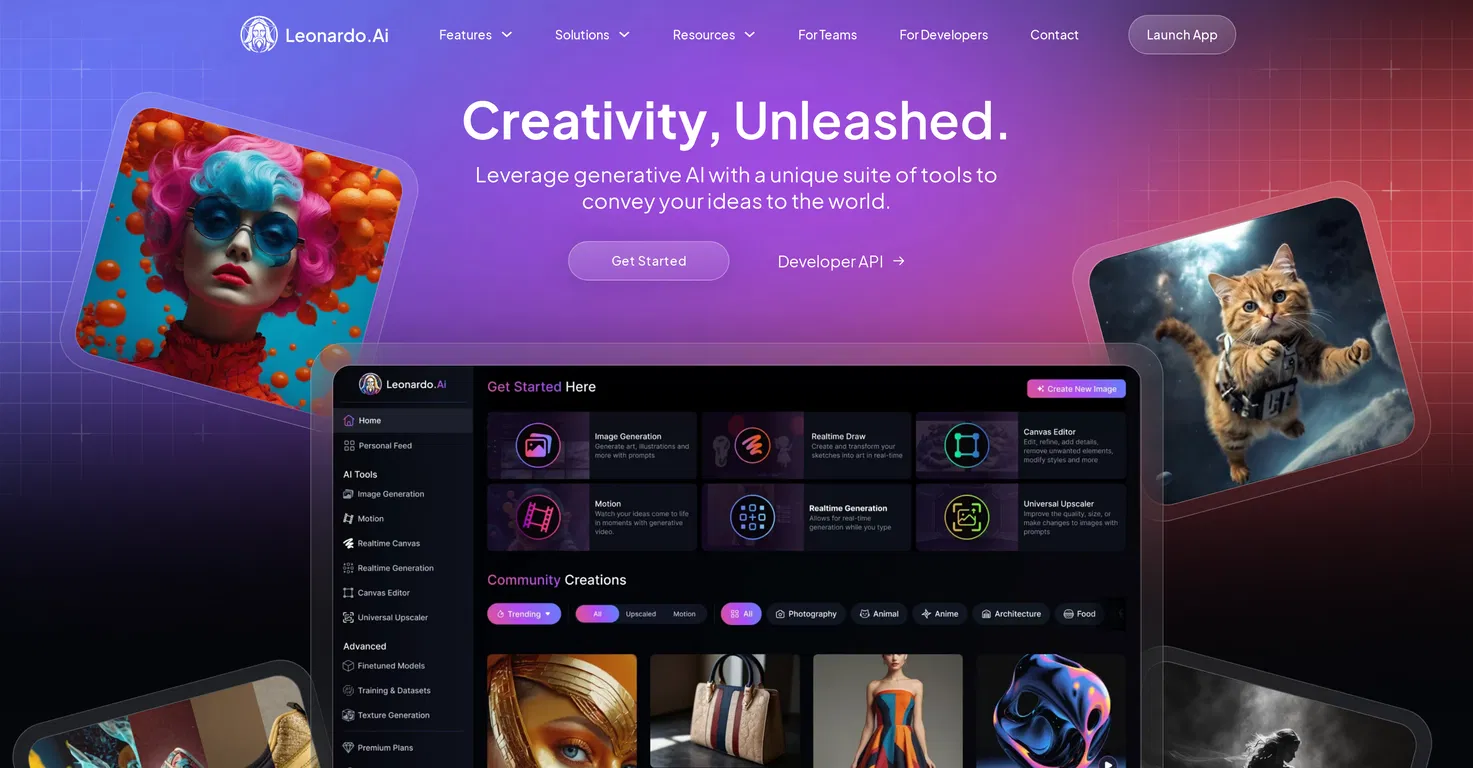
Leonardo AI is a generative art platform that creates images from text descriptions. Unlike some AI art tools that require Discord or technical knowledge, Leonardo runs entirely in your web browser. You type a description, click generate, and the AI creates artwork based on your words.
The platform offers over 50 AI models, including community-trained options for specific art styles. It also includes editing tools like a canvas for modifying images, upscaling for higher resolution, and even a feature to create coloring book pages from generated art.
Think of it as a creative studio where your child describes what they want to see, and the AI brings it to life. Want a dragon playing basketball on the moon? A rainbow castle made of candy? The AI will give it a try.
Is Leonardo AI Safe for Kids?
Leonardo AI is built with strict content moderation. The platform blocks Not-Safe-For-Work prompts by default. If someone tries to generate inappropriate content, the system refuses and displays an error.
The filtering is genuinely strict. Users in the Leonardo community have noted that even moderately edgy prompts get blocked. One creator making romance novel covers complained that the results always came out "too tame" because the filters would not allow anything beyond completely family-friendly imagery. For parents, this over-cautious approach is actually reassuring.
The platform uses automated AI moderation and continuously updates its safeguards. Newer image models based on Stable Diffusion XL are specifically chosen because they are less prone to producing inappropriate imagery than older models.
That said, no AI filter is perfect. The system might occasionally produce something unexpected, especially with prompts involving monsters, fantasy battles, or spooky themes. Parental supervision remains important, particularly for younger children.
Age Requirements
Leonardo AI has a clear policy: children under 13 are not allowed to create accounts or use the service alone. This means if your child is under 13, you should hold the account and supervise their usage directly.
Teenagers aged 13 to 17 may create accounts, but parental guidance is still recommended given the creative freedom the platform offers.
Pricing: What Does Leonardo AI Cost?
Leonardo operates on a freemium model with token-based generations. Each image you create costs tokens, and different plans provide different monthly allowances.
Free Tier
You get 150 tokens per day at no cost. This is enough for roughly 10 to 15 images depending on your settings. Generation speed is slower than paid plans, especially during peak hours.
Important: On free accounts, all generated images are public by default. They can be seen by other users and may appear in search results. If you want your child's creations to stay private, you will need a paid plan.
Apprentice ($12/month)
Provides 8,000 tokens per month with access to private generation mode. Good for regular light use or families who want privacy without heavy volume.
Artisan ($30/month)
Offers 25,000 tokens per month with faster rendering speeds. Suitable for more serious use or classroom projects requiring many images quickly.
Maestro ($60/month)
Provides 60,000 tokens per month with priority support. This is overkill for most families unless you are running large-scale projects.
Teams (Custom pricing)
Designed for multi-seat access with SSO login and private shared galleries. Could be useful for educators managing an entire class, though it is more of an enterprise offering.
For most families, the free tier is a good starting point. If your child enjoys it and you want privacy for their creations, the $12 Apprentice plan provides a reasonable upgrade.
Setting Up Leonardo AI Safely
Here is how to get started with appropriate safety measures in place.
Step 1: Create the Account Yourself
If your child is under 13, create the account using your own email. Even for teenagers, consider starting with a parent-controlled account until you understand how the platform works.
Step 2: Choose Safe AI Models
Leonardo offers many different AI models, each producing different visual styles. For family use, stick with the newer SDXL-based models like Leonardo Creative or PhotoReal v2. These produce cleaner results with less chance of unexpected artifacts.
Avoid older models or community-trained anime models, which may have been fine-tuned on less carefully curated data.
Step 3: Understand Privacy Settings
If you are on the free tier, assume everything generated is public. Do not upload personal photos or include identifying information in prompts.
If you upgrade to a paid plan, enable private mode for generations you want to keep within your family. This also prevents your images from being used to train Leonardo's AI models.
Step 4: Set Expectations
Explain to your child that the AI is not perfect. Sometimes it will create weird results: extra fingers, asymmetrical faces, or backgrounds they did not ask for. This is normal with AI art. The goal is experimentation and iteration, not perfection on the first try.
Features Kids Will Love
Leonardo has several features that work particularly well for family creative projects.
Batch Generation
Instead of creating one image at a time, Leonardo can generate 4, 8, or even 16 variations from a single prompt. This is perfect for brainstorming. Your child can describe their idea, see multiple interpretations, and pick their favorite.
Realtime Canvas
The Canvas feature lets kids sketch something rough, then watch the AI refine it in real-time. They can change the prompt and see the image update live. It is genuinely engaging to watch words transform into pictures.
The canvas also supports inpainting (regenerating part of an image) and outpainting (extending an image beyond its borders). If your child draws a character but wants a different background, the AI can fill it in.
Coloring Book Generator
Leonardo can turn generated images into line art suitable for coloring. Generate a custom image of your child's favorite animal or character, convert it to a coloring page, print it out, and they have a personalized coloring activity. Great for rainy days or long car trips.
Describe with AI
This feature works in reverse. Upload an image your child likes, and Leonardo will guess a prompt to create similar images. It is a fun way to learn how descriptions connect to visuals, and it can teach kids about being specific with language.
Motion Feature
Leonardo can animate still images into short looping video clips. A picture of a dragon can become a dragon breathing fire. This adds another dimension to storytelling projects.
Practical Tips for Better Results
Getting good results from Leonardo takes some practice. Here are tips that will help your family sessions go more smoothly.
Be Specific with Prompts
Vague prompts produce generic results. Instead of "a cat," try "a fluffy orange tabby cat wearing a wizard hat, sitting on a stack of books, digital art style." The more detail you provide, the closer the result will match your child's vision.
Use Negative Prompts
Leonardo lets you specify what you do not want in the image. If results keep including unwanted elements, add them to the negative prompt box. For example: "no text, no watermark, no extra limbs." This is particularly useful for avoiding common AI quirks like distorted hands.
Start Simple, Then Refine
Begin with a basic prompt, see what the AI produces, then add details in subsequent generations. This teaches kids an iterative creative process rather than expecting perfection immediately.
Manage Token Usage
On the free tier, 150 tokens per day goes faster than you might expect. Complex prompts at high quality can use 5 to 10 tokens each. Help your child plan their prompts rather than rapidly clicking generate. Consider it a creative challenge: what is the best image we can make with our remaining tokens today?
What Leonardo AI Struggles With
Understanding the limitations helps set appropriate expectations.
Text in Images
If you prompt an image that includes written text, like a sign or a book cover, the letters will likely be gibberish. This is a limitation of current AI image models, not specific to Leonardo. Plan to add any text manually afterward.
Consistent Characters
Getting the same character to look identical across multiple images is difficult. The AI tends to produce similar-but-not-quite-same faces each time. There are workarounds involving seeds and reference images, but they require more advanced techniques.
Prompt Interpretation
Sometimes Leonardo ignores parts of your description or adds elements you did not request. If this happens, try rephrasing or simplifying the prompt. It can take several attempts to communicate exactly what you want.
Occasional Weirdness
AI art commonly produces distortions: missing fingers, extra eyes, asymmetrical features. Newer models have improved significantly, but expect the occasional odd result. Kids often find these funny rather than frustrating.
Real-World Testing: What We Found
When we first explored the coloring book feature with our 5-year-old, Maria, she asked for "a unicorn princess in a rainbow castle." Leonardo generated a detailed fantasy scene in seconds. We converted it to line art, printed it out, and she spent a happy afternoon coloring her custom creation. The personalization made it far more engaging than a generic coloring book page.
The Canvas feature proved popular with our 8-year-old, Mateo. He drew a rough spaceship shape, and watching the AI transform his basic sketch into a detailed spacecraft in real-time was genuinely magical for him. When the first result included an unwanted planet in the background, we used the negative prompt to remove it on the next generation. That small problem-solving moment became a lesson in how to communicate with AI tools.
Both sessions highlighted something important: Leonardo works best as a collaborative tool where parents guide the process, rather than something kids use completely independently.
When Leonardo AI Makes Sense for Families
Leonardo AI is a good fit if:
- You want a browser-based tool that works on school Chromebooks or tablets
- Your children are interested in digital art and creative experimentation
- You can supervise sessions, especially for children under 13
- You value strong content filtering over creative freedom
- You want to explore AI art without complex Discord setups
It may not be the best choice if:
- You need completely unsupervised access for young children
- Privacy is critical and you cannot afford a paid plan
- You want perfect, consistent results without iteration
- Your child gets frustrated easily by imperfect outputs
Getting Started
Ready to try Leonardo AI with your family? Here is the quickest path:
- Visit Leonardo AI and create a free account using your email
- Choose a newer SDXL-based model from the model selector
- Start with a simple, specific prompt describing something your child wants to see
- Generate 4 variations and discuss which one you like best and why
- Experiment with the Canvas or coloring book features for more interactive fun
The free tier gives you enough tokens to explore whether the platform fits your family's creative style. If it clicks, consider upgrading for privacy and faster generation. If not, you have lost nothing but a bit of time experimenting.
For more details on Leonardo AI's features and capabilities, check out our full Leonardo AI review.