

Is Your Teen Learning or Letting AI Do It?
ON THIS PAGE
Subscribe To Get Weekly Family AI Discoveries

- The question changes at 14: your teen uses AI alone, unsupervised, and can hide it, so the honest-vs-copying line matters more than it ever did
- One controlled study was stark: kids with unrestricted AI did 48% better on practice but 17% worse on the real test
- The whole difference comes down to one thing: whether the AI hands over the answer or withholds it
- You do not need to ban AI. You need to change how it is used, and there is a prompt for that
- This is the exact worry your teen's teachers have too, which makes it a conversation worth having with the school
When my kids were small, AI was something we did together at the kitchen table. I typed, they watched, I was the filter. But the parents I hear from most now are not worried about a six-year-old. They are worried about a 14-year-old doing homework alone in their room with a chatbot open, and no way to know whether that is real learning or AI homework cheating dressed up as a finished assignment.
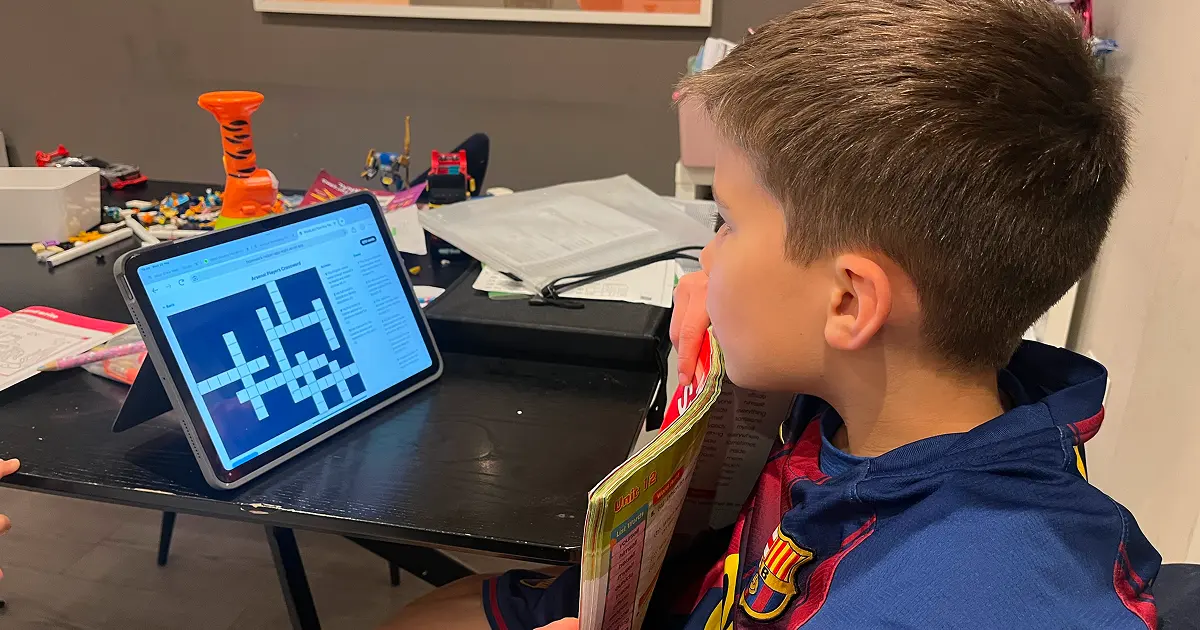
I have spent over 500 hours testing AI with my three kids, and I will be straight with you: my eldest is nine, so I can show you the principle at his level, but the research on teenagers makes the stakes much higher. The good news is the thing that decides whether AI helps or harms is the same at nine and at sixteen, and once you see it you cannot unsee it.
In this guide: what the research actually found, the single line that separates learning from cheating, five signs your teen is copying rather than learning, and what to do instead of banning it.
Not sure which tool is right for your child?
Take our free 2-minute quiz and get personalized AI tool recommendations based on your child's age and interests.
Why this changes at 14, not at 9
A younger child uses AI with a parent in the room. A teenager uses it the way they use everything else: privately, independently, and on their own phone. That is not a criticism, it is just the age. But it means three things are suddenly true at once. Your teen can use AI on any assignment. You usually will not see it happen. And the work that comes back can look completely finished while your child learned nothing from it.
That last one is the real risk, and it is not the risk most parents brace for. The danger is not that AI will show a teenager something inappropriate. It is that AI will quietly do the thinking that was supposed to build the skill.
What the research actually found
There is now real evidence here, not just opinion. In a controlled experiment run by the University of Pennsylvania's Wharton School, high-school maths students were split into three groups. The group handed an unrestricted AI assistant scored 48% better while they practised, and then 17% worse than their peers on the real test once the AI was taken away. They felt like they were learning. The exam said otherwise.
| How the AI was used | During practice | On the real test | Verdict |
|---|---|---|---|
| Unrestricted AI | 48% better | 17% worse | Looked like learning, was not |
| Hint-only AI tutor | Strong | Same as no AI | Learned it, kept it |
| No AI (textbook) | Baseline | Baseline | The control group |
The same body of research found the opposite result from a different setup. Students who used an AI tutor that gave hints instead of answers scored about the same as students with no AI at all, and crucially they did not get worse. I wrote up the full studies and what changed my mind in does AI hurt kids' learning.
💡 Parent Insight: The tool is not the villain and it is not the hero. The same AI, used two different ways, produced opposite results when the test came. What matters is not whether your teen uses AI. It is whether the AI does the work or makes them do it.
Is AI homework cheating, or studying? The one line that decides
Here is the whole thing in a sentence. If the AI gives the answer, it is doing the work. If the AI withholds the answer and makes your child produce it, it is teaching.
I can show you exactly what that looks like, even with a nine-year-old. When my son is stuck on nine times seven, the lazy prompt is "what is nine times seven." The prompt I actually use is: "Do not give the answer. Ask my son one question at a time to help him work it out himself." Same tool. Same problem. One version builds nothing, the other builds the skill. For a teenager wrestling with quadratic equations or an essay argument, the principle is identical, the stakes are just higher. And the study behind all this was not run on primary-school kids, it was run on teenagers in high-school maths classes, which is exactly why I lean on it for this age group.
5 signs your teen is copying, not learning
None of these on its own means cheating. They are reasons to ask a question with curiosity, not proof of anything. And do not go hunting for robotic writing, look for these instead.
- The work is finished but they cannot explain it. Ask them to walk you through one answer out loud. If they cannot, the AI understood it and they did not, though nerves can hide real understanding too, so ask gently.
- It is suspiciously fast. A week of homework done in twenty minutes is worth a second look.
- The quality jumped overnight with no struggle in between. Real learning has a messy middle. A sudden clean leap usually means the middle got skipped.
- They resist showing you the working. Not the final answer, the process. When something was copied, there is no process to show.
- Grades on homework and grades on tests are drifting apart. This is the practice-looks-great, test-looks-worse pattern showing up in your own house.
What to do instead of banning it
Banning AI outright mostly teaches a teenager to hide it better, and it puts them at a disadvantage against every classmate who is learning to use it well. The better move is to change the rules of use.
Start with the school's rules, not yours. What actually counts as cheating is set by your child's school, and often by each individual assignment. Some tasks allow AI, some ban it outright, and some require your teen to say they used it. Read that policy before you set a single rule at home, because a school's "no AI on this one" overrides any hint-not-answer arrangement you make.
Set the hint-not-answer rule. The house rule is simple: AI is allowed to ask questions, explain, and check work. It is not allowed to produce the answer. Give them the withholding prompt above as a starting template.
Be honest that the rule is a norm, not a lock. Your teen can open a fresh chat and ask for the answer outright, and no house rule stops that. So do not sell it as a technical barrier. Sell it as an agreement, and let the explain-it-back check below be the real enforcement. Frame it as partnership, not surveillance: I am not checking up on you, I want to know the AI is leaving you smarter, not just finishing your work.
Make them the teacher. After any AI-assisted session, they have to explain one thing back to you with the screen closed. If they can teach it, they learned it.
Point them at tools built to tutor, not to finish. Study tools like NotebookLM that work only from their own notes and sources are a very different thing from a blank chatbot that will write the whole essay.
Talk to the teacher. This is the part parents skip. Your teen's school is wrestling with the exact same question, and most teachers will tell you their policy and what good use looks like if you ask. It is the same worry from the other side of the desk, which I dug into in what teachers actually say about AI making kids lazy.
⚠️ Worth remembering: Age limits vary by tool, so check each one. Claude, for example, requires users to be 18+, while ChatGPT and Gemini allow 13+ with a parent's consent. Here is how old you actually have to be to use Claude and why.
Frequently asked questions
Is using AI for homework cheating?
It depends on two things. First, your school's policy: many set rules per assignment, and a "no AI on this task" instruction means no AI even for hints, so check that first. Second, for everything the policy does not cover, the test is whether the AI did the thinking or supported it. Using it to produce an answer your teen submits as their own is cheating; using it to explain, quiz, or check working is studying.
How can I tell if my teen used AI on an assignment?
Skip the AI-detector tools, they are unreliable. Ask your child to explain one answer out loud with the screen closed. Understanding cannot be faked; a finished document can.
Should I ban AI for schoolwork?
A full ban usually backfires. It teaches concealment and leaves your teen behind classmates who are learning to use AI well. Changing how it is used works better than banning that it is used.
What AI tools are okay for a teenager studying?
Favour tools that tutor rather than finish: ones that give hints, quiz from their own notes, or explain step by step. Be wary of any tool whose main job is producing a finished essay or answer set.
Teaching this year?
If you teach, I would genuinely like to know what is working in real classrooms. Tell me the grade and subject you teach and I will share what other teachers on my list are finding, plus a heads-up when I test something new for the classroom.
Join and tell me your class →AI tools, tested with my own kids, every Sunday
Each week I try a tool with my three kids and send parents and teachers the honest results, the wins, the flops, and what I'd never let a child near. Free, no hype, one email a week.
Join the newsletter →